Exam Review
- The patient has undergone open chest surgery for coronary artery bypass grafting. One of the nurse's responsibilities is to monitor the patient for which common postoperative dysrhythmia?"A)Premature junctional contractionsB)Ventricular ectopyC)Second degree heart blockD)Atrial fibrillation or flutter
- A patient is admitted with the diagnosis of unstable angina. The nurse knows that the physiological mechanism present is most likely which of the following?A)Partial occlusion of a coronary artery with a thrombusB)Complete occlusion of a coronary arteryC)Vasospasm of a coronary arteryD)Fatty streak within the intima of a coronary artery
- A 45-year-old man presents to the emergency department with a complaint of chest pain that started an hour ago. He describes the pain as a pressure-like sensation that radiates to his left arm. His past medical history is significant for hypertension and hyperlipidemia. On examination, his vital signs are: blood pressure 140/90 mmHg, heart rate 78 beats per minute, respiratory rate 18 breaths per minute, and oxygen saturation 98% on room air. An electrocardiogram (ECG) shows normal sinus rhythm without any ST-segment changes. Which of the following is the most appropriate next step in the management of this patient? (Select All that Apply.)(SATA)A)Perform a stress test immediatelyB)Discharge the patient with instructions to follow up with his primary care physicianC)Administer sublingual nitroglycerin and obtain cardiac enzymesD)Start the patient on oral aspirin and a statinE)Reassure the patient and provide analgesics for pain relief
- The nurse is caring for a recently admitted patient and notes the following priority intervention?
A ✓ Correct 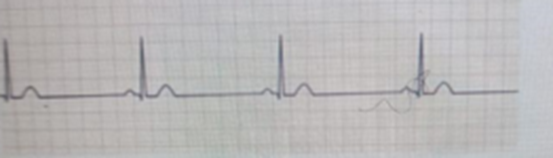 A)Administer Atropine 0.5 mg IVPB)Start a Dobutamine infusion to stimulate heart functionC)Pace the patient at a rate of 72 beats per minuteD)Obtain vital signs and neurologic status
Page 1 of 7
Exam Review
- Treating pain should be a priority over providing sedation. True or FalseA)TrueB)False
- Mr. Jones, 65-year-old male patient with a history of COPD is admitted to the hospital for exacerbation. He is using accessory muscles to breathe and exhibits a respiratory rate of 28 breaths per minute. His oxygen saturation is 88% on room air. Which of the following assessments is most important to monitor in a patient with COPD experiencing an exacerbation?A)Respiratory rate and effortB)Heart rateC)TemperatureD)Blood pressure
- Family presence is encouraged during resuscitation and invasive procedures. Which findings about this practice have been reported in the literature? (Select all that apply.)(SATA)A)Presence reduces nurses' involvement in explaining things to the family.B)Families report that staff conversations during this time were distressing.C)Families report reduced anxiety and fear about what is being done to the patient.D)Presence encourages family members to seek litigation for improper care.E)Families benefit by witnessing that everything possible was done.
- The patient's heart rate is 165 beats per minute and his cardiac monitor shows a rapid rate with narrow QRS complexes; the waves cannot be seen, but the rhythm is regular. The patient is symptomatic, so the nurse prepares the patient for:A)administration of beta-blockers.B)transcutaneous pacemaker insertion.C)emergent cardioversion.D)administration of atropine.
Page 2 of 7
Exam Review
- What are the categories for delirium?A)Hypo-reflexive, hyperactive, mixedB)Hyperactive, hypoactive, mixedC)Hypertensive, sedated, mixedD)Hyper-reflexive, hypoactive, sedated
- Of the following responses, what would you expect to see in left sided heart failure? (Select all that apply)(SATA)A)Elevated PCWP, tachycardia/tachypneaB)Cough, edemaC)Dyspnea, weight gain. Cheyne-Stokes respirationD)Fatigue, crackles, coughE)JVD. increased abdominal girthF)Edema, S3 and S4
- A 70-year-old female patient is admitted with pneumonia. She is exhibiting shortness of breath, a cough producing yellow sputum, and decreased breath sounds in the left lower lobe. A chest X-ray shows consolidation in the left lung. Her arterial blood gas (ABG) results indicate hypoxemia. What is the primary pathophysiological mechanism of V/Q mismatch in this patient with pneumonia?A)Increased perfusion with decreased ventilationB)Normal ventilation and normal perfusionC)Increased ventilation with decreased perfusionD)Decreased perfusion and normal ventilation
- The nurse is caring for a patient whose ventilator settings include 15 cm H2O of positive end- expiratory pressure (PEEP). The nurse understands that although beneficial, PEEP may result in:A)high cardiac index secondary to more efficient ventricular function.B)low cardiac output secondary to increased intrathoracic pressure.C)fluid overload secondary to decreased venous return.D)hypoxemia secondary to prolonged positive pressure at expiration.
Page 3 of 7
Exam Review
- While caring for a patient with a small bowel obstruction, the nurse assesses a pulmonary artery occlusion pressure (PAOP) of 1 mm Hg and hourly urine output of 5 ml. The nurse anticipates which therapeutic intervention?A)VasopressorsB)DiureticsC)Negative inotropic agentsD)Intravenous fluids
- The nurse is caring for a mechanically ventilated patient and notes the high pressure alarm sounding and cannot quickly identify the cause of the alarm. The nurse's priority action is to:A)ask the respiratory therapist to get the patient a new ventilator.B)manually ventilate the patient while calling for a respiratory therapist.C)call the rapid response team to assess the patient.D)continue to search for and find the cause of the alarm and fix it.
- One of the complications we might see of heart failure is cardiogenic shock. What kinds of signs and symptoms might you see and how do we treat? (Select all that apply)(SATA)A)Looks a lot like failure, both left and right, 53, crackles, hypertension. JVD, edemaB)Hypertension, 54, tracheal deviation, edemaC)Diuretics, insulin, ARBSD)IV vasodilators (preload and afterload)E)Positive inotropes to contractilityF)Circulatory assist devices
- The charge nurse is responsible for making the patient assignments on the critical care unit. An experienced, certified nurse is assigned to care for the acutely ill patient with sepsis who also requires continuous renal replacement therapy and mechanical ventilation. The nurse with less than 1 year of experience is assigned to two patients who are more stable. This assignment reflects implementation of theA)Quality and Safety Education for Nurses (QSEN) model.B)National Patient Safety GoalsC)Synergy Model of PracticeD)Crew resource management model.
Page 4 of 7
Exam Review
- The nurse is to calculate gtt/min to transfuse one unit (300 mL) of Packed Red Blood Cells (PRBC 's) over two hours using blood tubing that has a drop factor of 10 gtts/minA)15B)25C)20D)10
- The nurse notices ventricular tachycardia on the heart monitor. When the patient is assessed, the patient is found to be unresponsive with no pulse. The nurse should:A)Begin cardiopulmonary resuscitation and advanced life support.B)treat the patient with intravenous amiodarone or lidocaine.C)ignore the rhythm since it is benign.D)provide electrical cardioversion per physician protocol
- The nurse is caring for a patient in the critical care unit and notes the patient in the rhythm below. If the patient is unresponsive and pulseless, what should the nurse do?A)ignore the rhythm because it is benignB)provide immediate defibrillationC)treat with intravenous amiodarone or lidocaine.D)provide electrical cardioversion.
- PH7.28 PaCO2 46 mm Hg Bicarbonate 22 mEq/L Pa 02 58 mm Hg 02 saturation 88% What interdisciplinary staff member does the nurse notify to assist in the care of this patient while preparing to carry out provider orders?A)Phlebotomy to obtain another set of blood gassesB)Respiratory therapist to adjust ventilatorC)Social worker to notify familyD)Nursing assistant to help reposition the patient
Page 5 of 7
Exam Review
- Which of the following assists the critical care nurse in ensuring that care is appropriate and based on research?A)Consulting with advanced practice nursesB)Intensivist preferencesC)Implementing clinical practice guidelinesD)Computerized physician order entry
- What might be the advantages of NMB in a ventilated patient? (Select all that apply)(SATA)A)Prevent bucking the ventilatorB)Increase peak airway pressuresC)Increased oxygen demandD)Increased oxygen deliveryE)Improve chest wall compliance
- The nurse is caring for a patient who has a chest tube. Attached to the top of the patient's bed are two hemostats. In which situations would these be used? (Select all that apply.)(SATA)A)Physician orders to assess whether the patient is ready to have the chest tube removedB)To quickly empty or change disposable systemsC)To accurately assess lung sounds once a shiftD)To assess an air leakE)To quickly seal off the lungs if the system becomes disconnected
- The nurse is reading the cardiac monitor and notes that the patient's heart rhythm is extremely irregular and there are no discernible P waves. The ventricular rate is 90 beats per minute, and the patient is hemodynamically stable. The nurse realizes that the patient's rhythm is:A)atrial flutter.B)atrial flutter with rapid ventricular responseC)atrial tachycardiaD)atrial fibrillation
Page 6 of 7