Exam Review
- Provided is an ECG image of ventricular fibrillation. Identify the wave pattern and describe its characteristics.A)The wave pattern shows rapid, chaotic, and irregular electrical activity with no identifiable P waves or QRS complexes.B)The wave pattern shows a regular rhythm with a heart rate exceeding 150 beats per minute and widened QRS complexes.C)The wave pattern shows a saw-tooth appearance with a consistent atrial rate and regular ventricular response.D)The wave pattern shows a normal sinus rhythm with occasional premature ventricular contractions.
- Provided is an ECG image of sinus bradycardia. Identify the wave pattern and describe its characteristics.
A ✓ Correct 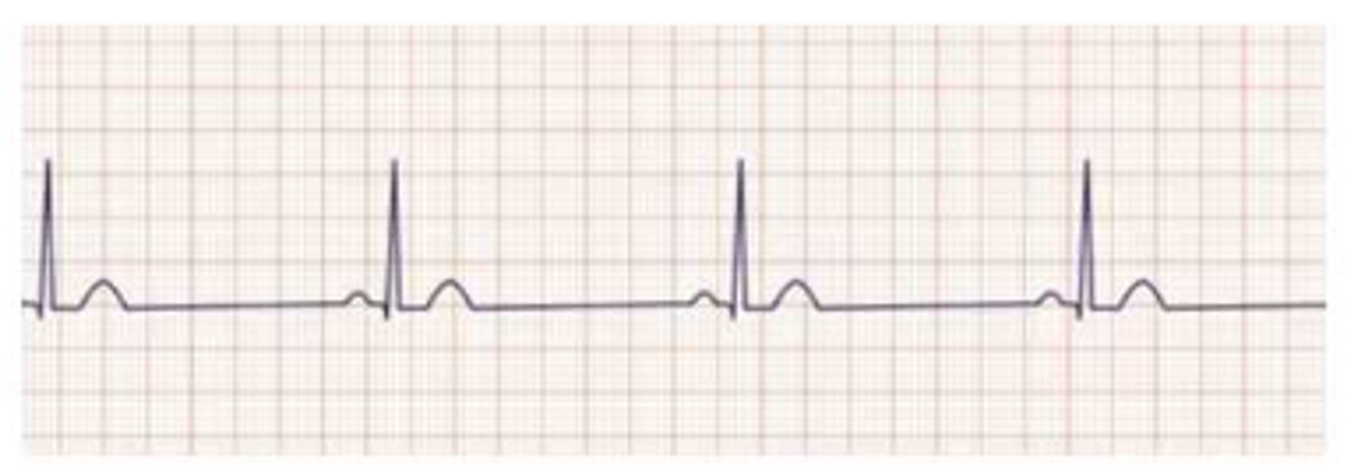 A)The wave pattern shows a normal sinus rhythm with a heart rate of less than 60 beats per minute.B)The wave pattern shows an absence of P waves and a heart rate of 40 beats per minute.C)The wave pattern shows a prolonged PR interval greater than 0.20 seconds with a slow rate.D)The wave pattern shows a regular rhythm with a heart rate between 60 and 100 beats per minute.
 - The nurse is assigned to care for several clients admitted to a telemetry unit. Which client should the nurse assess first?A)A client whose implantable cardioverter defibrillator (ICD) fired twice on the prior shift, requiring amiodarone IV.B)A client diagnosed with new onset of atrial fibrillation, requiring scheduled IV diltiazem.C)A client returned from an electrophysiology procedure 2 hours ago, reporting constipation.D)A client who received elective cardioversion 1 hour ago and whose heart rate (HR) is 115 bpm.
- A nurse is providing teaching to a client who has atrial fibrillation and reports dizziness and palpitations. Which of the following should the nurse understand is the cause of these manifestations?A)The heart's electrical transmission through the atrioventricular (AV) node is unusually slow.B)The heart's electrical signals are rapid, chaotic, and irregular.C)The SA node sends an electrical signal greater than 100/min.D)An early electrical signal occurs before the expected sinoatrial (SA) node signal.
Page 1 of 12
Exam Review
- The constant noise of a ventilator, monitor alarms, and infusion pumps predispose the patient to:A)Powerlessness.B)Frustration.C)Physical pain.D)Sensory overload.
- The healthcare provider has ordered an angiotensin-converting enzyme (ACE) inhibitor for the client diagnosed with congestive heart failure. Which discharge instructions should the nurse include?A)Instruct the client to take a cough suppressant if a cough develops.B)Explain the importance of taking the medication with food.C)Orthostatic hypotension may occur with ACE inhibitors as a result of vasodilation.D)Encourage the client to eat bananas to increase potassium level.
- A nurse is admitting a client who has acute heart failure following myocardial infarction (MI). The nurse recognizes that which of the following prescriptions by the provider requires clarification?A)0.9B)Bumetanide 1 mg IV bolus every 12 hr.C)Laboratory testing of serum potassium upon admission.D)Morphine sulfate 2 mg IV bolus every 2 hr PRN pain.
- The nurse on the telemetry unit has just received the A.M. shift report. Which client should the nurse assess first?A)The client diagnosed with CHF who has 1+ pitting edema.B)The client diagnosed with myocardial infarction who has an audible S3 heart sound.C)The client with chronic renal failure who has an elevated creatinine level.D)The client diagnosed with pneumonia who has a pulse oximeter reading of 94
Page 2 of 12
Exam Review
- Provided is an ECG image of sinus tachycardia. Identify the wave pattern and describe its characteristics.A)The wave pattern shows a regular sinus rhythm with a heart rate greater than 100 beats per minute.B)The wave pattern shows a regular rhythm with a heart rate between 60 and 100 beats per minute.C)The wave pattern shows an irregular rhythm with P waves that change in morphology.D)The wave pattern shows a rapid rate with no visible P waves and narrow QRS complexes.
- Diagnostic imaging reveals that the quantity of fluid in a client's pericardial sac is dangerously increased. The nurse should collaborate with the other members of the care team to prevent the development of which complication?A)Pulmonary edema.B)Cardiac tamponade.C)Pericarditis.D)Pericardiocentesis.
- A nurse is teaching a client who has acute pericarditis. Which of the following statements should the nurse include in the client teaching to explain the cause of pericarditis?A)Your heart condition is caused by thickening of the ventricular walls and septum.B)Your heart condition is caused by inflammation of the membranous sac that encloses the heart.C)Your heart condition is caused by excessive stretching of the ventricles.D)Your heart condition is caused by compression of the myocardium due to fluid that has accumulated around the heart.
- A nurse is teaching a client who has a new diagnosis of atrial fibrillation. The nurse should instruct the client to monitor for which of the following complications?A)Bradycardia.B)Peripheral vascular disease.C)Pulmonary embolism.D)Hypertension.
Page 3 of 12
Exam Review
- A nurse is monitoring an older adult female client who had a myocardial infarction (MI) for the development of an acute kidney injury. Which of the following findings should the nurse identify as indicating an increased risk of acute kidney injury (AKI)?A)Serum creatinine 2.1 mg/dL.B)Serum Osmolality 290 mOsm/kg H2O.C)Magnesium 2.0 mEq/L.D)Blood urea nitrogen (BUN) 20 mg/dL.
- A nurse is teaching a client who has mitral valve stenosis that has not responded to pharmacological therapies about other treatment options. Which of the following statements should the nurse include in their teaching?A)A flexible catheter will be inserted into a vessel of the arm, neck, or groin and advanced to the heart to dilate a narrowed or occluded artery.B)A heparin bolus is administered and followed with a continuous infusion to help keep the blood thinner.C)Pentoxifylline can be administered to help the platelets from sticking together and occluding the vessels.D)A small catheter with a balloon on the end is threaded into a vessel in the groin and advanced to the heart where the balloon will be inflated, and the narrowed valve will be dilated.
- A patient had a cardiac catheterization and is now in the recovery area. What nursing interventions should be included in the plan of care? Select all that apply.(SATA)A)Assess the peripheral pulses in the affected extremity.B)Assess the insertion site for bleeding or hematoma.C)Evaluate the temperature and color in the affected extremity.D)Encourage ambulation as soon as possible to avoid DVT.E)Restrict fluid intake to prevent fluid overload.
- The nurse is caring for a client with a history of endocarditis. Which topic would the nurse prioritize during health promotion education?A)Oral hygieneB)Dietary guidelines.C)Physical activity.D)Fluid intake.
Page 4 of 12
Exam Review
- A nurse in an emergency department is assessing a client who is having a suspected acute myocardial infarction (MI). Which of the following manifestations should the nurse expect to find for a client experiencing an acute MI? Select all that apply.(SATA)A)Orthopnea.B)Headache.C)Diaphoresis.D)Tachycardia.E)Nausea.
- The client has just returned to the floor after balloon valvuloplasty of the aortic valve and the nurse is planning appropriate assessments. The nurse would assess for all potential complications except.A)Emboli.B)Mitral valve damage.C)Plaque formation.D)Ventricular dysrhythmia.
- The physician prescribes 0.15 mg of digoxin IV push for a heart failure patient. The available dose is 1 mg/1 ml. How many milliliters will the nurse administer?
- A client is awaiting the availability of a heart for transplant. What option may be available to the client as a bridge to transplant?A)Pacemaker.B)Ventricular assist device (VAD).C)Intra-aortic balloon pump (IABP).D)Implanted cardioverter-defibrillator (ICD).
Page 5 of 12
Exam Review
- To reduce the risk of aneurysm rupture, the nurse should implement all of the following except.A)Maintain bedrest with the legs elevated.B)Administer antihypertensive and beta-blockers as prescribed.C)Instruct client to prevent straining during defecation and avoid holding the breath while moving.D)Maintain a calm environment and implement measures to reduce psychologic stress.
- A patient is admitted to the emergency department with chest pain and ECG findings showing ST-segment elevation. The nurse notes oxygen saturation at 89 Which intervention should the nurse prioritize to initiate first?A)Administer nitroglycerin immediately to reduce chest pain and lower blood pressure regardless of hemodynamic status.B)Administer supplemental oxygen to maintain saturation above 94C)Place the patient in supine position to optimize cardiac output and prepare for administration of morphine for pain control.D)Start thrombolytic therapy immediately as first-line treatment before obtaining vascular access or ECG monitoring.
- The nurse prepares discharge instructions for a patient recovering from percutaneous transluminal coronary intervention (PTCI). What medication information should the nurse include with this teaching?A)Ibuprofen.B)Warfarin.C)Plavix.D)Heparin.
- A client scheduled for cardiac catheterization is anxious and asks the nurse the reason for this test. What is the nurse's best response?A)Cardiac catheterization is usually done to assess how blocked or open a client's coronary arteries are.B)Cardiac catheterization is most commonly done to detect how efficiently a client's heart muscle contracts.C)Cardiac catheterization is most commonly done to evaluate cardiac electrical activity.D)Cardiac catheterization is usually done to evaluate cardiovascular response to stress.
Page 6 of 12