Exam Review
- A nurse on a medical-surgical unit is caring for a client who has a history of congestive heart failure (CHF). Complete the diagram by dragging from the choices below to specify what condition the client is most likely experiencing, 2 actions the nurse should take to address that condition, and 2 parameters the nurse should monitor to assess the client's progress.✓Elevate the client’s feet✓Administer IV fluids✓Hypovolemic shock✓Pulse pressure✓Mental statusActions to Take Choices✓Elevate the client’s feet✕Administer 1 unit of packed RBCs✕Administer IV antibiotics✓Administer IV fluids✕Obtain a lactate levelPotential Condition Choices✓Hypovolemic shock✕Septic shock✕Obstructive shock✕Cardiogenic shockParameters to monitor Choices✕Blood culture✕Temperature✕Platelet count✓Pulse pressure✓Mental status
- A nurse is caring for a client who takes lisinopril for hypertension. Which of the following client statements indicates an adverse effect of the medication?A)"I seem to be bruising more easily."B)"I have a heightened sense of taste."C)"I have a nagging, dry cough."D)"I have to urinate frequently."
- A nurse is caring for a client who reports abdominal pain. The nurse is caring for a client who has abdominal pain. Which of the following actions should the nurse take? Select all that apply.(SATA)A)Ensure client is NPOB)Ensure the client is on bed rest.C)Prepare to insert a nasogastric tube.D)Provide the client with foods that are high in fiber.E)Administer a laxative to prevent constipation.F)Position client in high-Fowler's position.G)Administer an enema to promote bowel evacuation.
- A nurse is caring for a client who has heart failure. After reviewing the findings, which of the following actions should the nurse take? For each potential provider's prescription, click to specify if the prescription is anticipated, nonessential, or contraindicated for the client.
Anticipated Nonessential Contraindicated Decrease the client's oxygen to 1 L/min via nasal cannula. ✓ Begin a 24-hr urine collection for the client. ✓ Restrict the client's fluid intake to 2 L per day. ✓ Hold the client's metoprolol. ✓ Increase the dosage of furosemide. ✓ Weigh the client daily. ✓
Page 1 of 25
Exam Review
- A nurse is performing a cranial nerve assessment on a client following a head injury. Which of the following findings should the nurse expect if the client has impaired function of the vestibulocochlear nerve (cranial nerve VIII)?A)Deviation of the tongue from midlineB)Disequilibrium with movementC)Inability to smellD)Loss of peripheral vision
- A nurse is assessing a client following the insertion of a central venous catheter. Which of the following findings indicates a pneumothorax?A)Distended neck veinsB)Diminished breath soundsC)Irregular heart rateD)Itching over the incision
- A nurse is reviewing a client's cardiac monitor for dysrhythmias. Which of the following findings should the nurse identify as an indication for the placement of a permanent pacemaker?A)Vasovagal bradycardia without syncopeB)Sinus tachycardia with rates faster than 80/minC)Complete AV block with rates slower than 40/minD)Asymptomatic second-degree AV block
- A home health nurse is teaching a client who has heart failure. Which of the following responses should the nurse identify as an indication that the client understands the teaching?A)"I should take ibuprofen for a headache."B)"I will weigh myself at different times of the day to monitor fluid retention."C)"I can have a total of 4 grams of sodium each day."D)"I should be able to have a conversation while exercising."
Page 2 of 25
Exam Review
- A nurse is caring for a client who is postoperative following a total knee arthroplasty. The client tells the nurse. "I will not be able to play with my grandchildren anymore." Which of the following responses should the nurse make?A)"Why do you think you won't be able to play with your grandchildren?"B)"You will not be as active for a couple years."C)"I am sure you will be able to still spend time with your grandchildren."D)"What are some of the activities you like to do with your grandchildren?"
- A nurse is caring for an older adult client who is 1 hr postoperative following a transurethral resection of the prostate and is receiving continuous bladder irrigation. Which of the following findings should the nurse report to the provider?A)Decreased urinary outputB)Client urge to voidC)Moderate painD)Pink-tinged urine
- A nurse is teaching a client and his partner about performing peritoneal dialysis at home. When discussing peritonitis, which of the following manifestations should the nurse identify as the earliest indication of this complication?A)FeverB)Increased heart rateC)Cloudy effluentD)Generalized abdominal pain
- A nurse finds a client in bed, unresponsive and breathing. Which of the following actions should the nurse take first?A)Initiate cardiac monitoring for the client.B)Apply a blood pressure cuff.C)Establish an IV access.D)Palpate for the client's carotid pulse.
Page 3 of 25
Exam Review
- A nurse is caring for a client who has ulcerative colitis and was admitted to the medical-surgical unit for management of diarrhea. Which of the following food items should the nurse select for the client's breakfast tray?A)OatmealB)Whole grain toastC)Poached eggD)Fresh peaches
- A nurse is caring for a client who has advanced liver disease. Which of the following laboratory results should the nurse monitor when assessing this client?A)Glucose levelB)Serum troponinC)Phosphate levelD)Serum ammonia
- A home health nurse is planning to use nonpharmacological pain relief measures for a client who has severe chronic back pain. Which of the following pain management guidelines should the nurse use?A)Pain relief from the use of heat and cold continues for several hours after removal of the stimulus.B)Discontinue opioids before trying nonpharmacological methods of pain relief.C)Distraction changes the client's perception of pain, but it does not affect the cause.D)Use imagery with clients who have difficulty with focus and concentration,
- A nurse is providing discharge teaching to a client who has a permanent pacemaker. Which of the following statements by the client indicates an understanding of the teaching?A)"I need to maintain pressure over the pacemaker site with an elastic bandage."B)"The pacemaker will deliver a shock if I develop a dysrhythmia."C)"When a microwave oven is in use, I need to stay out of the room."D)"I need to check my pulse rate every day for a full minute."
Page 4 of 25
Exam Review
- A nurse is monitoring a client's heart rhythm following insertion of a permanent pacemaker. Which of the following images should the nurse expect? A. B. C.
A ✓ Correct 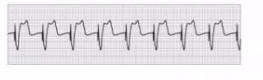
B 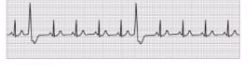
C 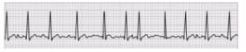 A)AB)BC)C
 - A nurse is planning care for a client who has had a recent cerebrovascular accident (CVA). Which of the following actions should the nurse include in the plan of care to decrease the client's risk for footdrop?A)Elevate the extremity above the heart.B)Reposition the client every 2 hr.C)Use padded splints.D)Apply a sequential compression device.
- A nurse is caring for a client who has an indwelling urinary catheter. Which of the following actions should the nurse take when performing a closed intermittent irrigation?A)Clamp the catheter above the specimen port.B)Inject the irrigation solution slowly into the catheter.C)Use a 3-mL syringe to perform the catheter irrigation.D)Place the client in the Trendelenburg position.
- A nurse is preparing to discontinue long-term total parenteral nutrition (TPN) therapy for a client. The nurse should plan to discontinue the TPN gradually to reduce the risk of which of the following adverse effects?A)HyperglycemiaB)ConstipationC)DiarrheaD)Hypoglycemia
Page 5 of 25
Exam Review
- A nurse is teaching a client who is to begin chemotherapy about a peripherally inserted central catheter (PICC). Which of the following statements should the nurse include in the teaching?A)"We will replace the PICC every month."B)"We will change the dressing daily."C)"We can draw blood samples from the PICC for diagnostic tests.D)"We can measure your blood pressure in either arm."
- A home health nurse is assessing a client who has COPD, Which of the following findings indicates the need for a referral for pulmonary rehabilitation?A)Pursed-lip breathingB)SaO₂ 92%C)Dyspnea at restD)Clubbing of the fingers
- A nurse is caring for a client following a synchronized cardioversion. Which of the following findings indicates a therapeutic response to the treatment?A)Cardiac monitor indicates sinus rhythm.B)Diminished breath sounds on auscultation.C)Pacer spikes precede the QRS complex on the ECG tracing.D)Weak peripheral pulses on palpation.
- A nurse is planning care for a client who is 8 hr postoperative following a coronary artery bypass grafting. Which of the following assessments should the nurse plan to perform first?A)Auscultate breath sounds.B)Measure the client's core body temperature.C)Palpate pulses distal to the graft donor site.D)Examine the surgical incision for drainage.
Page 6 of 25