Exam Review
- The practical nurse (PN) is observing a newly hired PN who is preparing to administer a liquid medication via a client's feeding tube system as seen in the picture. What action should the PN take?
A ✓ Correct 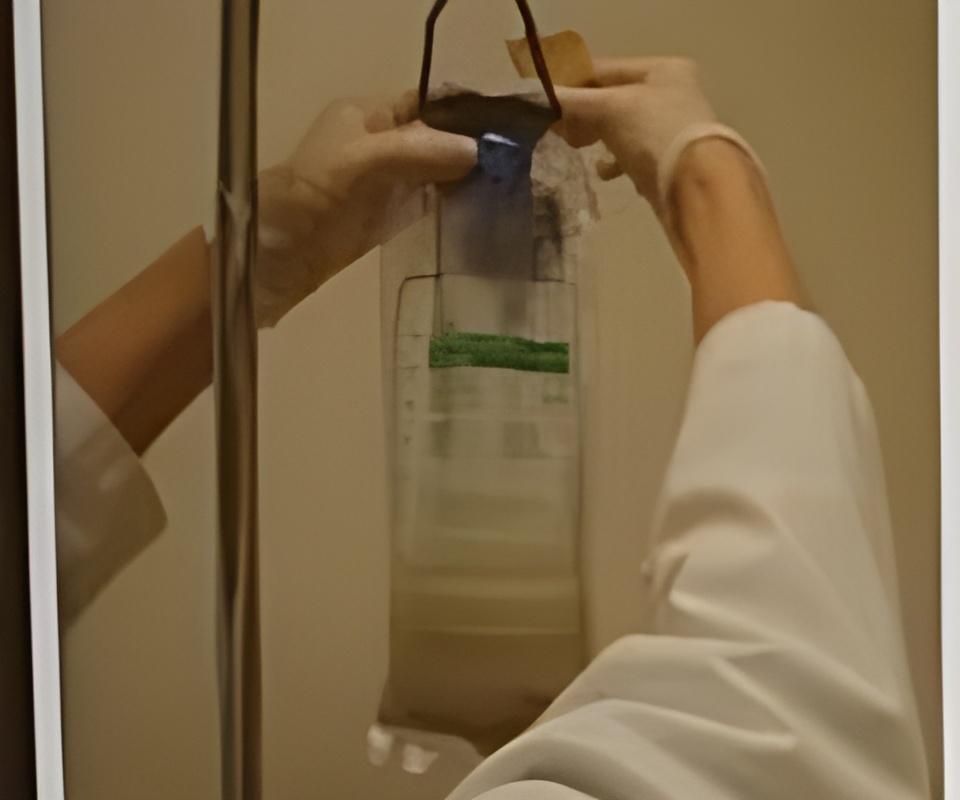 A)Demonstrate how to administer medication via a feeding tube.B)Confirm that the medication is only administered once dailyC)Determine if the medication is compatible with the solution.D)Offer to assist in calculating the rate of flow for the mixture.E)NoneF)None
 - A client with obsessive-compulsive disorder (OCD) reports, "Thoughts stick in my mind and the rituals I use are stupid, but I cannot control them. People laugh at me, but they do not understand how awful it is. I am a burden to my family because I cannot hold a job. I do not know how much longer I can live this way." Which information is most important for the practical nurse (PN) to ask in response to the client's statements?A)Question about which rituals are most often used to reduce anxiety.B)Ask if the obsessions and compulsions interfere with sleep.C)Inquire if the distress could lead to considering suicide as an option.D)Determine what makes the client think people are laughing.
- An elderly client is 12-hours postoperative for a hernia repair and suddenly becomes agitated, staggers out into the corridor, and demands to be set free. After assisting the client back to bed and administering pain medication, which intervention is best for the practical nurse (PN) to implement?A)Administer a prescribed narcotic antagonist to reverse the effects of any analgesic accumulationB)Notify the healthcare provider and request a prescription for restraints to minimize the client's danger to self.C)Raise the side rails and notify the family to come and stay until the client is reoriented and cooperativeD)Instruct a UAP to keep the upper side rails up and check on the client every 15 minutes until the client is resting.
- Which actions should the practical nurse (PN) include when assessing a client for signs and symptoms of fluid volume excess? (Select all that apply.)(SATA)A)Palpate the rate and volume of the pulse.B)Check fingernails for the presence of clubbing.C)Measure body weight at the same time dailyD)Observe the color and amount of urineE)Compare muscle strength of both arms.
Page 1 of 19
Exam Review
- The charge nurse brings a #18 urinary catheter with a 30 mL balloon to the practical nurse (PN) who is preparing to insert a catheter in a female client who weighs 50 kg. Which action should the PN take first?A)Obtain a 30 mL syringe and a vial of sterile water.B)Ask the client if she has previously been catheterized.C)Consult with the charge nurse about the catheter.D)Position the client and observe the urinary meatus.
- The birth weight of an infant delivered by a woman with gestational diabetes is 10.1 pounds (4,581 grams). The infant is jitery and has a heel stick glucose level of 40 mg/dL (2.2 mmol/L) 30 minutes after birth. Based on this information, which intervention should the practical nurse (PN) implement first? Reference range: Blood glucose neonate: [30 to 60 mg/dL or 1.7 to 3.3 mmol/L]A)Offer nipple feedings of 10% dextrose.B)Begin frequent feedings of breast milk or formulaC)Repeat the heel stick for glucose in one hourD)Assess for signs of hypocalcemia
- A client is being treated for chronic kidney disease (CKD). On examination, the client has an elevated blood pressure (BP) and is exhibiting changes in mental status. Which intervention in the plan of care should the practical nurse (PN) implement?A)Use a cushion when sitting.B)Perform range of motion exercises.C)Document abdominal girth.D)Weigh every morning.
- The practical nurse (PN) prepares to remove a client's saline lock. Which supplies should the PN gather? (Select all that apply.)(SATA)A)Small gauze pad.B)Paper tape.C)Three mL syringe.D)Exam gloves.E)Sterile gloves.
Page 2 of 19
Exam Review
- An older female adult who was admited to a long-term care facility yesterday is confused about what day of the week it is. Her history does not indicate that she was confused prior to admission. What action should the practical nurse (PN) take?A)Document the client's loss of memory in the record.B)Notify the family of the change in the client's condition.C)Remind the client what day of the week it is.D)Encourage the client to rest during the day.
- In assessing a 2-year-old boy with croup, the practical nurse (PN) finds that he has become increasingly irritable and has developed tachypnea and resting stridor. Which intervention is best for the PN to implement?A)Instruct the mother to play with the child for stimulation and distractionB)Administer a dose of acetaminophen as neededC)Monitor the child's oxygen saturation level via pulse oximetry.D)Encourage the child to drink adequate amounts of fluids
- The healthcare provider prescribed octreotide 150 mcg/day subcutaneously for a client with dumping syndrome. The medication is available in 0.2 mg/mL vials. How many mL should the practical nurse (PN) administer? (Enter numerical value only. If rounding is required, round to the nearest hundredth).
- A chronically depressed older male resident of a long-term care facility has become more reclusive and today refuses to leave his room. His family has moved away and are unable to visit as much as in the past. Which comment by the practical nurse (PN) is likely to be most helpful to this client?A)“Come into the recreation area. We have your favorite card game and I will play it with you."B)"Why do you want to stay in your room today?”C)"I know you are sad about not seeing your family as often, but they are visiting as much as they can.”D)d “May I sit with you for a while?"
Page 3 of 19
Exam Review
- An older adult female asks the practical nurse (PN) if she should get a Herpes zoster (shingles) vaccination because she gets cold sores on her mouth when she is sick or stressed. Which response should the PN provide?A)The vaccine is not useful if you have ever had a case of shingles.B)If you are 60 or older, the one-time vaccination is recommendedC)You do not need to get this vaccination if you have had chicken poxD)The vaccination minimizes outbreaks of cold sores
- The practical nurse (PN) is caring for a client with coronary artery disease who is admitted with intermittent chest pain. The admission laboratory results indicate elevations in troponin I and creatine phosphokinase myoglobin isoenzyme (CK-MB) levels. What should the PN consider the most significant risk for this client on the second day of admission?A)The lab results indicate myocardial damage, and the client is at risk for cardiac dysrhythmiasB)The client is at risk for pulmonary embolism, and lifestyle modifications need to be implemented.C)The client is at risk for recurrent long-term angina pain and subsequent myocardial infarction (MI).D)The lab results indicate risk factors for transient ischemic atack (TIA), and neurological vital signs should be monitored.
- While caring for a client with Guillain-Barre syndrome, which finding should the practical nurse (PN) report to the charge nurse?A)Irregular heart rate.B)Profuse diaphoresis.C)Lower leg weakness.D)Full facial flushing.
- The practical nurse (PN) plans to screen only high risk children for scoliosis. Which group of children should the PN screen?A)High school boys.B)High school girls.C)Middle school boys.D)Middle school girls.
Page 4 of 19
Exam Review
- A client who had orthopedic surgery three days ago verbalizes difficulty in sleeping. Which initial intervention is best for the practical nurse (PN) to implement?A)Offer the client a prescribed sleep medication.B)Reposition the client and provide a back rub.C)Administer an as needed (PRN) prescription for pain.D)Provide a cup of hot chocolate at bedtime.
- The practical nurse (PN) observes two unlicensed assistive personnel (UAP) turning an older client who had a hip arthroplasty with prosthesis placement four hours ago. Which observation by the PN indicates that the UAPs need additional information about the turning procedure?A)An abduction pillow is placed between the client's legs when positioned.B)The client is told to keep both legs straight and together while turning.C)A turning sheet is used under the client for turning and repositioning.D)The UAPs keep their backs straight and knees bent when moving the client.
- The practical nurse (PN) is caring for an older client who is receiving chemotherapy for lung cancer. Which finding is the highest priority for the PN to report to the charge nurse? Reference ranges: Blood urea nitrogen (BUN): [Adult: 10 to 20 mg/dL or 3.6 to 7.1 mmol/L] Platelets: [150,000 to 400,000/mm3 or 150 to 400 x 10^9/L]A)Periodic nausea and vomitingB)Decreased deep tendon reflexesC)Platelet count 135,000/mm3 or 135 x 10^9/LD)Blood urea nitrogen 75 mg/dL or 12.9 mmol/L
- When gathering data about a client with dark skin tones, which site should the practical nurse (PN) observe?A)Hands and feet.B)Forehead and face.C)Finger and toe nails.D)Sclera and mucous membranes.
Page 5 of 19
Exam Review
- The practical nurse (PN) observes two unlicensed assistive personnel (UAP) turning an older client who had a hip arthroplasty with prosthesis placement four hours ago. Which observation by the PN indicates that the UAPs need additional information about the turning procedure?A)An abduction pillow is placed between the client's legs when positioned.B)The client is told to keep both legs straight and together while turning.C)A turning sheet is used under the client for turning and repositioning.D)The UAPs keep their backs straight and knees bent when moving the client.
- Prior to an invasive examination of a hospitalized client, a consent form should be obtained. Which action best describes the responsibility of the practical nurse (PN)?A)Explains the examination and asks the client to sign the consent form.B)Checks the medical record for the correct signed consent form prior to the examination.C)Explains to a family member and obtains their signature on the consent form.D)Asks if the client understands the exam and why the consent form must be signed.
- Which actions should the practical nurse (PN) include when assessing a client for signs and symptoms of fluid volume excess? (Select all that apply.)(SATA)A)Palpate the rate and volume of the pulse.B)Check fingernails for the presence of clubbing.C)Measure body weight at the same time daily.D)Observe the color and amount of urine.E)Compare muscle strength of both arms.
- An elderly client is 12-hours postoperative for a hernia repair and suddenly becomes agitated, staggers out into the corridor, and demands to be set free. After assisting the client back to bed and administering pain medication, which intervention is best for the practical nurse (PN) to implement?A)Administer a prescribed narcotic antagonist to reverse the effects of any analgesic accumulation.B)Notify the healthcare provider and request a prescription for restraints to minimize the client's danger to self.C)Raise the side rails and notify the family to come and stay until the client is reoriented and cooperative.D)Instruct a UAP to keep the upper side rails up and check on the client every 15 minutes until the client is resting.
Page 6 of 19