Exam Review
- The practical nurse (PN) applies and then releases pressure to a client's fingernail as seen in the photo. Normal nail color returns in 2 seconds. Which action should the PN take?
A 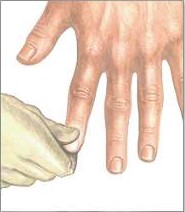 A)Report abnormal findings to the charge nurse.B)Observe for blanching of the nailbed.C)Repeat the process with a different nailbed.D)Document the capillary refill time.
 - A client who had a knee replacement surgery and received a prescription for enoxaparin 30 mg subcutaneously every 12 hours for 10 days. The medication is available in 30 mg per 0.3 mL pre-filled syringes. How many mL should the practical nurse (PN) administer each day? (Enter numerical value only.)
- In caring for a client who requires seizure precautions, the practical nurse (PN) should ensure the ready availability of equipment to perform which procedure?A)Suction the trachea.B)Insert a urinary catheter.C)Apply soft restraints.D)Insert a nasogastric tube.
- The practical nurse (PN) is told that she keeps her 2-year-old child in a playpen so he will not get dirty. Which statement should the PN use in responding to this concern about using a playpen?A)Overconcern about appearance can be harmful.B)Playpens provide a sense of security for the child.C)Playpens provide a safe environment for a toddler.D)Children need time to actively explore their environment.
Page 1 of 38
Exam Review
- At the first dressing change, the practical nurse (PN) tells the client that her mastectomy incision is healing well, but the client refuses to look at the incision and refuses to talk about it. Which response by the PN to the client's silence is best?A)"It's OK if you don't want to look or talk about the mastectomy. I will be available when you're ready."B)"Would you like me to call another nurse to be here while I show you the wound?"C)"Part of recovery is accepting your new body image, and you will need to look at your incision."D)"You will feel better when you see that the incision is not as bad as you may think."
- Prior to giving digoxin, the practical nurse (PN) assesses that a 2-month-old infant's heart rate is 120 beats/minute. Based on this finding, what action should the PN take?A)Administer the medication and alert the charge nurse.B)Hold the medication and document cardiac assessment.C)Administer the medication and document the heart rate.D)Hold the medication and recheck the heart rate in 1 hour.
- Which information should the practical nurse (PN) collect during the admission assessment of a terminally ill client to an acute care facility?A)Health care proxy documentation.B)Name of funeral home to contact.C)Client's wishes regarding organ donation.D)Contact information for the client's next of kin.
- The practical nurse (PN) learns that a client who is receiving chemotherapy has developed stomatitis. Which information should the PN obtain from the client during a focused assessment?A)Urinary output.B)Ability to swallow.C)Frequency of bowel movements.D)Blood pressure while standing.
Page 2 of 38
Exam Review
- A male client tells the practical nurse (PN) that the pill he has been taking at home is a different color and size than the one the PN is trying to give him now. How should the PN respond?A)Explain that the healthcare provider probably prescribed a different medication while he is hospitalized.B)Tell the client that he is probably confused since being hospitalized tends to disorient clients.C)Tell the client that the PN will verify that the dispensed medication is the valid prescription.D)Explain that the pharmacy often substitutes generic equivalents for more expensive brands.
- A client reports experiencing numbness and tingling in the extremities. Which of the client's serum laboratory values should the practical nurse (PN) prioritize reporting to the healthcare provider?A)HematocritB)Albumin and protein levelsC)ElectrolytesD)White blood cell count (WBC)
- The mother of a school-aged boy tells the practical nurse (PN) that he fell out of a tree and hurt his arm and shoulder. Which assessment should the practical nurse (PN) note as the most significant indicator of possible child abuse?A)The child looks at the floor when answering the nurse's questions.B)The mother describes in detail what she did for her injured child.C)The abrasions on the child's arms, legs, and chest have healed.D)The injury description by the mother varies from the child's version.
- A full-term, 24-hour-old infant in the nursery regurgitates and suddenly turns cyanotic. Which immediate intervention should the practical nurse (PN) implement?A)Turn the infant onto the right side.B)Suction the oral and nasal passages.C)Give oxygen by positive pressure.D)Stimulate the infant to cry.
Page 3 of 38
Exam Review
- The practical nurse (PN) determines that a client's pupils constrict as they change focus from a far object to a near object. How should the PN document this finding?A)Consensual pupillary constriction present.B)Nystagmus present with pupillary focus.C)Pupils reactive to accommodation.D)Peripheral vision intact.
- A 16-year-old client is asking the practical nurse (PN) what can be done about acne. Which recommendation should the PN provide?A)Wash the hair and skin daily with mild soap and warm water.B)Omit chocolate, carbonated drinks, and fried foods from the diet.C)Express blackheads and follow with an exfoliating scrub.D)Refer to the dermatologist for prescribed long-term therapy.E)NoneF)None
- A client with a compound fracture of the left ankle is being discharged with a below-the-knee cast. Which instruction should the practical nurse (PN) provide to the client prior to discharge?A)Apply a cold pack to any "hot spots" on the cast.B)Keep the left leg in a dependent position.C)Expect some increase in pain.D)Never scratch under the cast.
- A male preoperative client who has already signed the informed consent for a surgical procedure confides in the practical nurse (PN) that he is really frightened and unsure about undergoing the surgery. Which priority action should the PN take?A)Encourage the client to continue with the scheduled surgery.B)Document that the client has expressed concerns about the surgery.C)Notify the charge nurse of the client's concerns about surgery.D)Remind the client that the consent has already been obtained.
Page 4 of 38
Exam Review
- The parents of a one-year-old child with the diagnosis of hypospadias informed the practical nurse (PN) that they plan to delay corrective surgery to see if the child will outgrow the problem. Which information should the PN provide to these parents?A)Whatever the parents decide, the staff will be available to support the decision.B)The child's prognosis will not develop complications if surgery is delayed.C)Some children do outgrow this type of problem and waiting may be beneficial.D)Ask the parents to explain what they understand about the child's diagnosis.
- Before administering an antibiotic that can cause nephrotoxicity, which laboratory value is most important for the practical nurse (PN) to review?A)Serum calciumB)Hemoglobin and hematocritC)White blood cell count (WBC)D)Blood urea nitrogen (BUN) and creatinine
- The practical nurse (PN) is assessing an older client with left-sided heart failure (HF). What intervention is most important for the PN to implement?A)Inspect for sacral edema.B)Measure urinary output.C)Auscultate all lung fields.D)Check mental acuity.E)Check mental acuity.
- The practical nurse (PN) receives a report of a stable client who experienced partial-thickness burns over 30% of the body surface area (BSA) 3 days ago. Which complication is most important for the PN to anticipate?A)Elevated blood pressure.B)Curling's ulcer.C)Compartment syndrome.D)Excruciating pain.
Page 5 of 38
Exam Review
- The practical nurse (PN) is providing care for a client who is receiving an aminoglycoside to treat a bacterial infection. To assess for signs of ototoxicity, which action should the PN take?A)Check for changes in vision.B)Monitor the client's hearing.C)Observe the skin for a rash.D)Measure the urinary output.
- A client who is reaching saturation with medication reports the onset of muscle soreness and fatigue, and the practical nurse (PN) notes that the client's skin is warm to the touch. Which action by the PN is a priority?A)Administer a PRN dose of acetaminophen.B)Encourage the client to drink fluids.C)Report the findings to the charge nurse.D)Monitor the client's serum lipid levels.
- A college student brings his roommate to the clinic because the roommate has been talking to someone who is not present. The student tells the practical nurse (PN) that his roommate is acting strange. Which question should the PN ask the client next?A)"Are you planning to obey the voices?"B)"Have you taken any hallucinogens?"C)"When did these voices begin?"D)"Do you believe the voices are real?"
- The practical nurse (PN) notices that one of the unlicensed assistive personnel (UAP) working in the long- term care facility consistently records subnormal temperatures when using the thermometer. Which action should the PN take first?A)Show the UAP how to chart temperatures.B)Return the thermometer for recalibration.C)Observe how the UAP obtains temperatures.D)Demonstrate how to use the equipment.
Page 6 of 38