Exam Review
- The intracranial pressure (ICP) of a brain injured client who is on a ventilator has increased from 15 mm Hg to 25 mm Hg within the last 30 minutes. The client is beginning to flex all extremities intermittently. Based on these findings, which immediate action should the nurse take? Reference Range: Increased cranial pressure (ICP) [7 to 15 mm Hg]A)Manually ventilate the client using the ambu bag.B)Assess the patency of the client's artificial airway.C)Administer the prescribed PRN dose of morphine sulfate IV.D)Draw a stat arterial blood gas to assess for hypercapnia.
- A client is to receive mannitol IV for increased intracranial pressure. Which outcome may result from the use of mannitol?A)HypervolemiaB)HyperglycemiaC)HyponatremiaD)Oliguria
- Exhibits Which of the following findings should the nurse prioritize?A)Thick green mucusB)Lung soundsC)The tracheostomy stateD)Fraction of inspired oxygenE)NoneF)None
- Patient Data Exhibits The healthcare provider (HCP) would like to do a thoracentesis on the client. The client's caregiver asks the nurse if there are any contraindications for the procedure. Performing a thoracentesis is contraindicated in which clinical manifestation (s)? Select all that apply.(SATA)A)Unstable hemodynamicsB)Coagulation deficienciesC)HypertensionD)Mechanical ventilation requiredE)Tracheal deviationF)Infection
Page 1 of 15
Exam Review
- Patient Data Exhibits Choose the most likely options for the information missing from the statement(s) by selecting from the lists of options provided. The client likely has a(n) ▾ Obstructed tracheostomy and ▾ Traumatic iatrogenic pneumothorax.Dropdown 1:Option 1: Obstructed tracheostomyOption 2: Primary spontaneous pneumothoraxOption 3: Displaced tracheostomyOption 4: Traumatic iatrogenic pneumothoraxDropdown 2:Option 1: Primary spontaneous pneumothoraxOption 2: Displaced tracheostomyOption 3: Traumatic iatrogenic pneumothorax
- Patient Data Exhibits The rapid response team (RRT) is on its way to the bedside. Which 4 actions should the nurse perform immediately?(SATA)A)Call for a stat chest x-rayB)Collect supplies for a chest tubeC)Suction the clientD)Replace the tracheostomy tubeE)Increase the client's oxygenF)Place the client on a continuous pulse oximeter
- Patient Data Exhibits Which are important to monitor in this client following the chest tube placement? Select all that apply.(SATA)A)Chest circumferenceB)Arterial blood gas (ABG) resultsC)Bubbling in the water seal chamberD)Daily weightsE)Peak flow meter valuesF)Developmentally appropriate pain rating
- A client's telemetry monitor indicates ventricular fibrillation (VF). Which should the nurse do first?A)Administer epinephrine IV.B)Provide immediate defibrillation.C)Prepare for synchronized cardioversion.D)Give an IV bolus of amiodarone.
Page 2 of 15
Exam Review
- After two hours post coronary artery bypass surgery the client experienced a central venous pressure increasing from 13 mm Hg to 17 mm Hg within a half hour. The systolic blood pressure dropped to 90 mm Hg on inspiration and rose to 110 mm Hg on expiration. Heart sounds are distant upon auscultation, and decreased electrocardiogram (ECG) waveform amplitudes are assessed. Which is the cause of these clinical manifestations?A)Primary cardiomyopathy.B)Acute pericarditis.C)Infective endocarditis.D)Cardiac tamponade.
- After two minutes of cardiopulmonary resuscitation, the client's electrocardiogram (ECG) displays third degree heart block with no palpable pulse. Which intervention should the nurse implement?A)Apply external pacing pads.B)Obtain blood pressure reading.C)Insert second peripheral IV.D)Prepare epinephrine 1 mg IV.
- While caring for a client with a cervical spine injury, which assessment finding should the nurse report to the healthcare provider immediately?A)Sluggish pupillary response.B)Respiratory rate 6 breaths/minute.C)Average urinary output 20 mL/hour.D)Heart rate 140 beats/minute.
- Patient Data Exhibits Complete the diagram by dragging from the choices area to specify which condition the client is most likely experiencing, two actions the nurse should take to address that condition, and two parameters the nurse should monitor to assess the client's progress.✓Measure electrolyte levels✓Assess lung sounds✓Acute kidney injury✓Electrocardiogram✓Daily weightActions to Take Choices✕Hold pressure on the surgical site✕Give 1,000 mL of isotonic solution IV✕Alert the rapid response team✓Measure electrolyte levels✓Assess lung soundsPotential Conditions Choices✕Hypovolemia✕Hemorrhage✓Acute kidney injury✕Septic shockParameters to Monitor Choices✓Electrocardiogram✓Daily weight✕Hemoglobin✕Capillary refill✕Surgical site drainage
Page 3 of 15
Exam Review
- When caring for a client who is at risk for increased intracranial pressure (ICP), which intervention should the nurse implement to assist in stabilizing ICР?A)Suction oral cavity frequently to maintain a patient airway.B)Keep client's head in a midline position with head raised 30°.C)Extend neck with a soft collar placed at base of client's skull.D)Turn entire body from side to side at least every 2 hours.
- The nurse is completing a head to toe assessment for a client admitted for observation after falling out of a tree. Which finding warrants immediate intervention by the nurse?A)Clear fluid leaking from the nose.B)Sluggish pupillary response to light.C)Periorbital ecchymosis of right eye.D)Troubled with a severe headache.
- A client sustained a head injury when hit by lead pipe two hours ago and is admitted for observation after the computerized tomography (CT) scan indicates that no spinal cord injury and no skull fractures are present. When the client begins projectile vomiting, the nurse quickly turns the client's head to the side and administers ondansetron 4 mg IV as prescribed. Reassessment indicates that the client's Glasgow coma score is 13 and the left pupil is dilated without reaction to light. Which intervention(s) should the nurse implement? Select all that apply.(SATA)A)Place in lateral Trendelenburg position.B)Insert a second large bore IV catheter.C)Schedule a repeat CT scan.D)Apply artificial tear drops to left eye.E)Repeat Glasgow coma assessment.
- The healthcare provider prescribes heparin 18 units/kg/hr IV for a client who weighs 154 Ibs to prevent deep vein thrombosis (DVT). The premixed IV solution is labeled "Heparin Sodium 20,000 Units in Dextrose 5% in Water (D5W) 500 mL". The nurse should program the infusion pump to deliver how many mL/hr? (Enter numerical value only. If rounding is required, round to the nearest tenth.)
Page 4 of 15
Exam Review
- After several days of sedation and mechanical ventilation, a client is successfully extubated and is placed on oxygen 40% by face mask. While making rounds, the nurse finds that the client is confused and is attempting to get out of bed. Vital signs are temperature 99.2° F (37.3° C), heart rate 112 beats/minute, respirations 16 breaths/minute, blood pressure 100/70, and oxygen saturation 98%. Which action should the nurse take?A)Administer a benzodiazepine.B)Apply wrist restraints.C)Notify the rapid response team.D)Increase oxygen to 60%.
- A young adult male client is admitted to the emergency department (ED) following a motor vehicle collision and the nurse suspects that he has suffered a spinal cord injury (SCI). Which assessment finding, if present, will alert the nurse to suspect spinal shock?A)Dilated pupils.B)Hypertension.C)Tachycardia.D)Absence of reflexes.
- Based on this strip, which is the correct interpretation of this rhythm?
A ✓ Correct  A)Third degree AV block.B)Junctional rhythm.C)First degree AV block.D)Idioventricular rhythm.E)NoneF)None
 - An unconscious client is demonstrating pulseless ventricular tachycardia (PVT).The nurse checks the client's pulse and begins cardiopulmonary resuscitation (CPR). The defibrillator and crash cart arrive at the bedside and the client is shocked. Which action should the nurse implement next?A)Administer epinephrine IV push.B)Recharge the defibrillator and give one shock.C)Resume CPR, beginning with compressions.D)Administer amiodarone IV push.
Page 5 of 15
Exam Review
- A man brings his wife to the emergency department (ED) because she is confused and restless. He tells the nurse that they were in a motor vehicle collision early today and his wife bumped her head on the dashboard. The husband is very concerned about his wife and refuses to leave her bedside. Which intervention is most important for the nurse to implement?A)Orient the client to her surroundings.B)Allow husband to stay at bedside.C)Implement seizure precautions.D)Assess for drainage from ears or nose.
- Patient Data Exhibits The nurse is admitting the client to the stroke unit and preparing to complete a focused neurological assessment. Which assessment(s) should the nurse conduct? Select all that apply.(SATA)A)Romberg's testB)Pupil sizeC)Glasgow coma scaleD)Muscle toneE)Level of consciousnessF)Brudzinski reflexesG)Cranial nerves
- A client's chest tube becomes dislodged from the drainage system. Which action should the nurse take?A)Replace the drainage collection system.B)Clamp the tube near the insertion site.C)Place the tubing end into sterile water.D)Secure end of the tube with an occlusive dressing.
- An adult client is being admitted to the coronary care unit with a possible myocardial infarction (MI). The client reports feeling like they are going to "pass out." The cardiac monitor displays the rhythm shown. The client's respiratory rate is 12 to 16 breaths/minute and blood pressure is 78/52 mm Hg. The nurse auscultates clear breath sounds bilaterally and the skin is pale and diaphoretic. After administering oxygen, which action should the nurse prepare to perform?
A 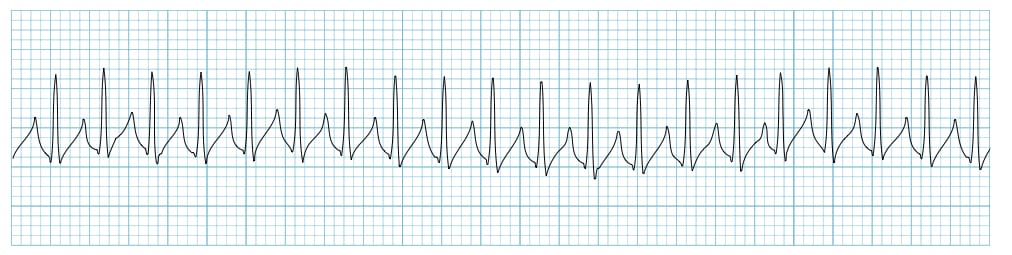 A)Assist the client to perform vagal maneuver or bear down.B)Give an anticholinergic medication.C)Administer a sedative and cardiovert the client.D)Give a beta blocker medication.
Page 6 of 15